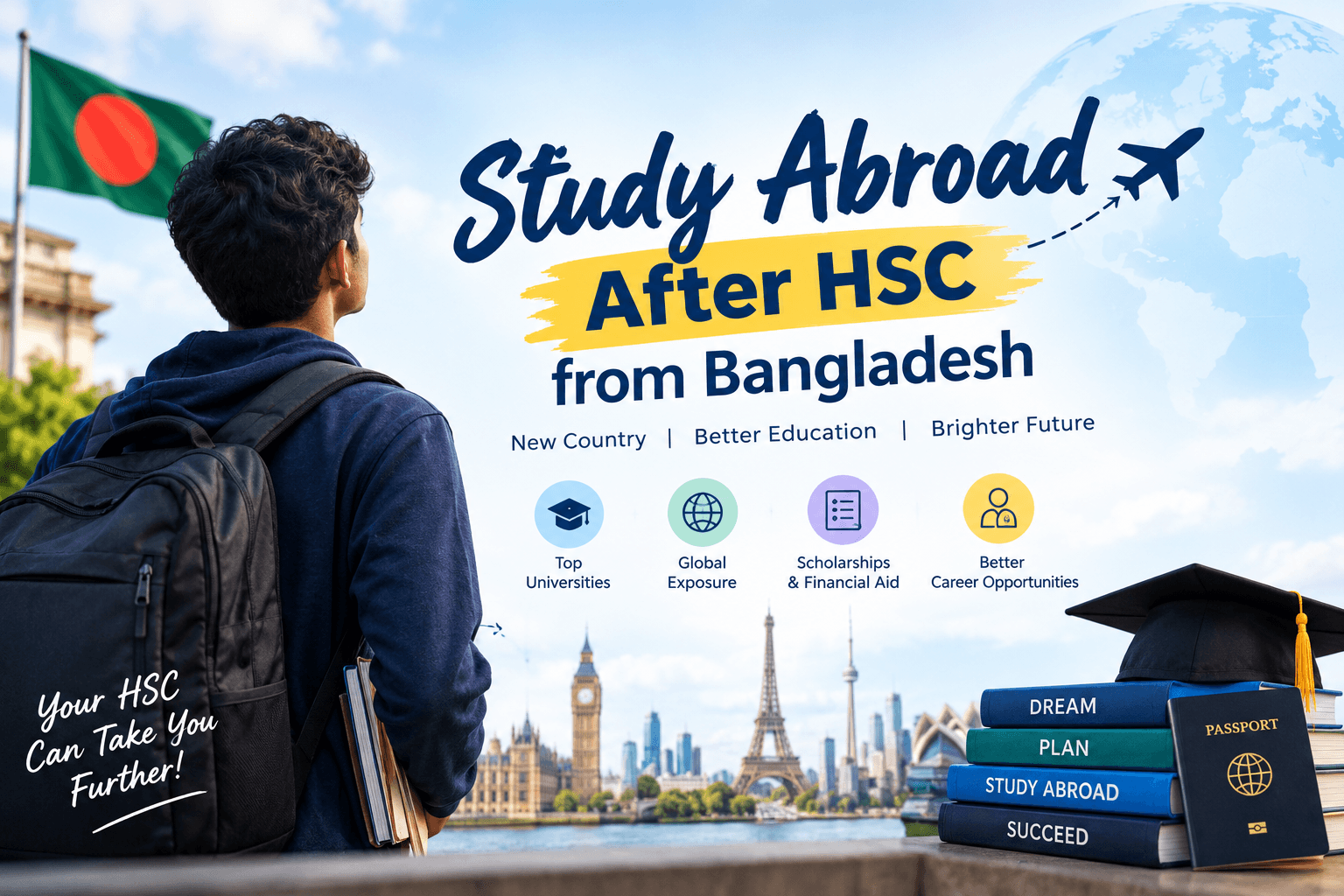
After HSC, Bangladeshi students can study abroad in the UK, Australia, Canada, Ireland, the USA, Germany, Finland, Sweden and Denmark. The usual steps are: choose a country and course, meet the academic and English requirements, apply to universities, receive an offer, prove your funds, and apply for a student visa. Most students need 6 to 9 months from first counselling to departure. The main intakes are January/February and September. NWC Education offers free counselling and end-to-end support.
You have finished HSC. Now comes the question every family asks: where do I go, what will it cost, and will my visa be approved?
This guide answers all three. It is written by NWC Education's counsellors, who have helped students go abroad since 2006 and have counselled 100,000+ students from over 65 countries.
Key facts at a glance
QuestionShort answerCan I study abroad right after HSC?Yes, for most destinations. Germany usually requires a preparatory year first (see below).Do I need IELTS?Often yes. Some universities accept alternatives or their own test.When should I start?6 to 9 months before your intake.Main intakesJanuary/February and September (Denmark: September only)Is counselling free at NWC?Yes.What decides my chances most?Your HSC GPA, your chosen course, your English score and your financial documents.
Why study abroad after HSC?
Globally recognised degrees. A degree from a UK, Australian, German or Nordic university is accepted by employers worldwide.
Career-focused learning. Many universities include internships, placements or industry projects. Others, such as University of South Wales and University College Birmingham, are known for practical, employer-linked courses.
International exposure. You study and live with people from dozens of countries, which builds confidence, communication and independence.
Post-study options. Many countries allow graduates to stay and work for a limited time. For example, Germany offers an 18-month job-seeking residence permit. Rules change often, so check before you decide.
Scholarships. Starting early gives you a real chance at tuition discounts and awards.
Which country is best after HSC? Compare side by side
CountryBachelor's lengthEntry after HSCEnglish requirementBest forUK3 years (4 in Scotland)Many universities accept HSC with strong results; others need a Foundation YearIELTS or accepted alternative; often 5.5-6.5 overallBusiness, IT, health, law, creative courses; shorter degreeAustralia3-4 yearsHSC plus a Diploma or Foundation in some casesIELTS/PTE; visa-level minimums have risenEngineering, IT, health, hospitalityGermany3-4 yearsMost HSC holders complete Studienkolleg (preparatory year) firstGerman or English depending on programmeEngineering, science; very low tuition at public universitiesFinland3-4 yearsVaries by university; some programmes use entrance examsEnglish-taught programmes require IELTS/equivalentEducation, technology, nursing, businessSweden3 yearsProgramme-specific; some require extra subjects or studyIELTS/equivalentDesign, engineering, sustainabilityDenmark3-4 yearsProgramme-specific; September intake onlyIELTS/equivalentBusiness, tech, design, health
Canada, Ireland and the USA are also available through NWC's 750+ partner network. Ask a counsellor for current options.
Honest advice from our counsellors: Do not choose a country because a friend went there. Choose the course first, then the country where that course fits your HSC result, budget and career plan.
Country guides for HSC students
Study in the UK after HSC
The UK is NWC's most popular destination. Many universities in our network, including Leeds, Sussex, Royal Holloway, Kingston, Greenwich, Cardiff Metropolitan and Birmingham City, accept international undergraduates. If your HSC grades fall slightly short, an International Foundation Year is a guaranteed-progression route into the same universities.
Current UK visa numbers (verify on GOV.UK before publishing):
Student visa fee: £558 (from 8 April 2026)
Immigration Health Surcharge: £776 per year
Living-cost funds: £1,529/month in London and £1,171/month outside London (up to 9 months), rising from 30 November 2026 to £1,570 and £1,203, which means £14,130 and £10,827 for nine months
Funds must normally be held for 28 consecutive days before applying
Study in Australia after HSC
Australia suits students who want strong employability and a high quality of life. A diploma or foundation course can bridge any academic gap and lead into the second year of a degree at some universities.
Current visa numbers (verify with Home Affairs):
Student visa (subclass 500) fee: reported at AUD 2,500 from 1 July 2026
Living-cost requirement: AUD 29,710 for 12 months
You must also pass the Genuine Student assessment, which replaced the old GTE test
Study in Germany after HSC
Most public universities charge little or no tuition, which attracts many Bangladeshi students. However, German universities generally treat Bangladeshi HSC (12 years) as not enough for direct bachelor's entry. Most students first complete a Studienkolleg year and pass its assessment exam, which usually requires German language skills.
Blocked account requirement: €11,904 per year (€992 per month)
Germany is not tuition-free in every case, and living costs are real
Study in Finland, Sweden and Denmark
These Nordic countries offer modern, research-led education and excellent quality of life. Entry rules vary by programme, and tuition for non-EU students is charged. Denmark's main intake is September, so deadlines come early.
👉 Finland · Sweden · Denmark · September intake in Denmark for Bangladeshi students
Best courses after HSC, by your HSC group
Your HSC groupStrong course options abroadScienceEngineering (civil, electrical, mechanical), Computer Science, Data Science, Pharmacy, Nursing, Biomedical Science, ArchitectureBusiness StudiesBusiness Management, Accounting & Finance, Marketing, International Business, Supply Chain, Hospitality & TourismHumanitiesLaw, Psychology, Media & Communications, Education, International Relations, Social Work, Design
Many universities let you change direction with a Foundation or Diploma. If you are unsure, book a counselling session before you shortlist.
What do you need to apply?
Academic
SSC and HSC certificates and transcripts (attested and often translated)
A minimum GPA or grade profile, which varies by university and course. Competitive courses ask for more.
English language
IELTS, PTE, TOEFL or Duolingo, depending on the institution
Some universities offer an interview or in-house test, or a language route for borderline scores
Documents
Passport (valid)
Personal statement or motivation letter
Recommendation letters (if requested)
CV (for some courses)
Proof of funds and sponsor documents
For students under 18: parental consent and guardianship arrangements may be required.
How much does it cost to study abroad after HSC?
Total cost = tuition + living costs + visa and health fees + travel and setup.
Cost areaUKAustraliaGermanyTuition (indicative, per year)Roughly £12,000-£25,000+ depending on course and universityRoughly AUD 25,000-50,000 depending on courseMostly low or none at public universities (some states charge non-EU fees)Visa fee£558AUD 2,500 (reported from July 2026)Varies by embassyProof of living funds£10,827-£14,130 (9 months, from 30 Nov 2026)AUD 29,710€11,904Health cover£776/year (IHS)OSHC (private, required)About €140-€150/month
Tuition ranges are indicative and vary widely. NWC counsellors give you the exact fee sheet for your chosen university before you apply.
How to fund it
Scholarships and fee discounts (merit-based, early-bird, country-specific)
Family sponsorship with clear, verifiable documents
Education loans
Part-time work rules vary by country, and you should not plan your finances around them
Study abroad timeline after HSC
WhenWhat to do8-9 months before intakeFree counselling, shortlist country and course7-8 monthsBook your English test, prepare personal statement6 monthsSubmit applications (multiple universities recommended)4-5 monthsReceive offers, compare scholarships, accept your offer3-4 monthsPrepare funds, pay deposit, receive CAS/COE/admission documents2-3 monthsApply for visa (28-day fund rule applies for the UK)1 monthBook accommodation, flights, insurance, attend pre-departure briefing
Intakes: January/February and September are the main ones. Admission processing usually takes 2 to 12 weeks, and visa processing is extra.
8 steps to study abroad after HSC
Book free counselling. We review your HSC result, budget and goals.
Choose your course and country. We compare options honestly, including the downsides.
Prepare English and documents. We guide you on test choice and attestation.
Apply. We submit your applications and track them.
Choose your offer and scholarship. We help you compare total cost, not just tuition.
Prove your funds. We explain how to present financial documents so they are clear and verifiable.
Apply for your visa. We prepare you, including interview or Genuine Student preparation where relevant.
Depart with confidence. Accommodation, travel and pre-departure support.
7 mistakes that cost students their offer or visa
Choosing the country before the course.
Applying to only one university.
Last-minute bank deposits with no history behind them, a common reason for visa trouble.
Weak personal statements copied from the internet.
Ignoring deadlines. Denmark's September intake and popular UK courses close early.
Using unverified agents who promise guaranteed visas. Nobody can guarantee a visa.
Not checking the total cost, including visa, insurance and living funds.
Why choose NWC Education to take you from HSC to your dream university?
Free counselling and application support, with no hidden charges for guidance
Since 2006, with 100,000+ students counselled
750+ partner institutions across the UK, Europe, Australia, Canada, the USA and more
British Council trained counsellors
Real offices in Dhaka, Chattogram and Sylhet, plus our London office
End-to-end service: course choice, applications, scholarships, funds guidance, visa and pre-departure support
You bring the ambition. We bring the plan.
Ready to turn your HSC result into a global future?
Book Your Free Counselling · Call +44 (0)203 488 1195 · Email apply@nwc.ac
Frequently asked questions
Can I study abroad right after HSC?
Yes. Students go to the UK, Australia, Canada, Ireland, the USA and the Nordic countries after HSC. Germany usually requires a preparatory year (Studienkolleg) first.
Which country is best to study abroad after HSC?
There is no single best country. The UK suits students who want a shorter degree, Australia suits those targeting practical, employable courses, and Germany suits students focused on low tuition and willing to complete a preparatory year. We choose by course, budget and GPA.
What GPA do I need to study abroad after HSC?
It depends on the university and course. Many universities accept a wide range of GPAs, while competitive courses such as medicine, law and top-ranked engineering ask for more. A Foundation Year can help if your GPA is below a university's direct-entry requirement.
Do I need IELTS to study abroad after HSC?
Often, but not always. Some universities accept PTE, TOEFL, Duolingo or their own English test. Visa rules can add their own English requirement, so your counsellor will check both.
How much does it cost to study abroad after HSC?
Costs depend on country and course. For the UK, you must show living funds of £10,827 outside London or £14,130 in London for nine months (from 30 November 2026), plus tuition. For Australia, the living-cost requirement is AUD 29,710. Germany requires €11,904 in a blocked account. Ask NWC for a personalised cost sheet.
Can I study abroad after HSC without IELTS?
Possibly. Some universities offer interviews, in-house tests or pre-sessional language courses. Always confirm that the visa route also accepts your option.
Which intake is best, January or September?
September is the main intake with the widest course choice and scholarships. January/February is useful if you are ready earlier or missed September. Denmark accepts students in September only.
How long does it take to get admission and a visa?
Admission usually takes 2 to 12 weeks, depending on the university and country. Visa processing is extra, so plan 6 to 9 months overall.
Can I get a scholarship after HSC?
Yes. Many universities offer merit-based scholarships and fee discounts for international undergraduates. Applying early improves your chances.
Can I work while studying abroad?
Many countries allow limited part-time work, but rules differ and change. Do not rely on part-time income to meet your visa financial requirement.
What if my HSC result is low?
You still have options: a Foundation Year, a Diploma, or a different course or country. Book counselling and we will show you a realistic route.
Does NWC charge for counselling?
No. NWC offers free counselling and application assistance.